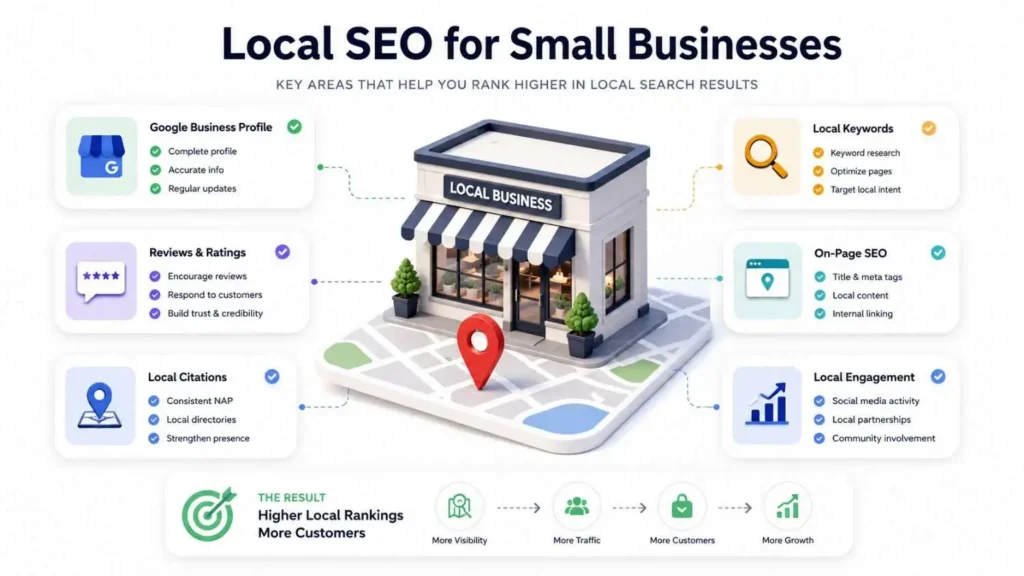
Local SEO for Small Businesses helps business owners improve their online visibility, attract more local customers, and increase sales through proven local SEO strategies. In this guide, you’ll learn everything you need to rank higher in local search results.
Here’s the biggest mistake I see in local SEO for small businesses: business owners filling their websites with copy-pasted content. A plumber in Austin grabs the same “About Us” paragraph a competitor used, swaps in their city name, and calls it done. A dentist hires someone to write five “service area” pages that are 90% identical except for the neighborhood name in the headline. It looks like progress. It feels like SEO. But it’s often actively working against the business.
For local SEO for small businesses, Google’s algorithms are built to detect duplicate and low-substance content, and even when a page doesn’t get penalized outright, it simply has nothing unique to rank for. If your “Plumbing Services in Round Rock” page says the same thing as your competitor’s “Plumbing Services in Round Rock” page — and the same thing as your own “Plumbing Services in Pflugerville” page — you’ve given search engines no reason to prefer you. Worse, you’ve given potential customers no reason to trust you either. They can smell template content from a mile away.
That’s the real starting point for local SEO for small businesses: not tactics, but substance. Everything below builds from that.
What Local SEO Actually Means (And Why It’s Different)
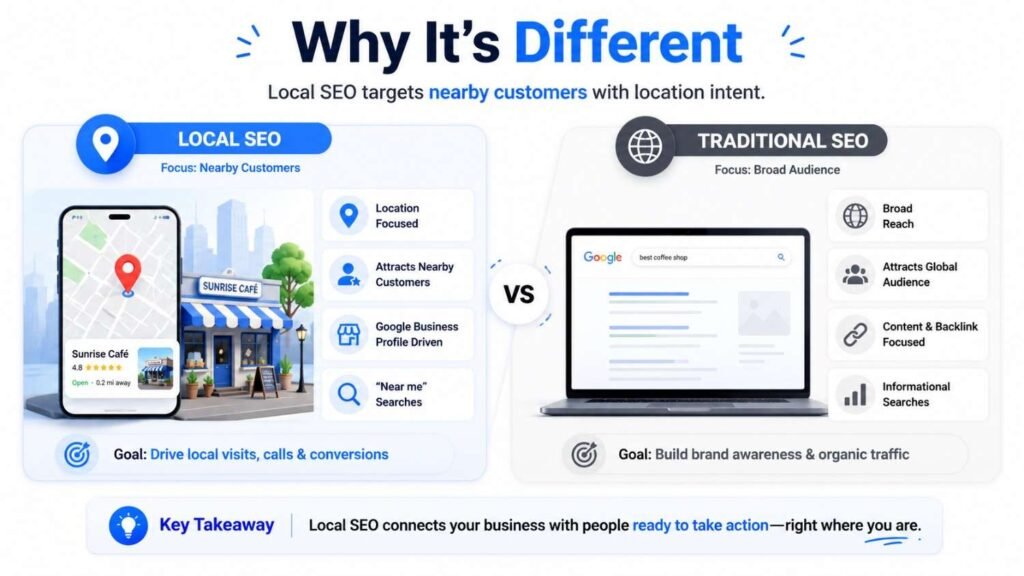
Local SEO for small businesses is the practice of optimising your online presence so your business shows up when people nearby search for what you offer — “electrician near me,” “best brunch in [neighbourhood],” “emergency vet open now.” It overlaps with traditional SEO but has its own ecosystem: Google Business Profile, local map rankings (the “map pack”), location-based citations, and reviews.
The reason local SEO deserves its own playbook is that local search results are judged on a different mix of signals than typical organic results. Google weighs three core factors for local rankings:
- Relevance — how well your business matches what someone searched for
- Distance — how close you are to the searcher or the location they specified
- Prominence — how well-known and well-reviewed your business is, both online and off
Step 1: Fix Your Google Business Profile Before Anything Else
Local SEO for Small Businesses If you do nothing else from this guide, do this Your Google Business Profile (GBP) is usually the single highest-leverage asset in local SEO for small businesses because it’s what actually shows up in the map pack and in Google Maps results, because it’s what actually shows up in the map pack and in Google Maps results.
To succeed with local SEO for small businesses, get these details right:
- Primary category matches exactly what you do (don’t pick “Business Consultant” because it sounds broader — specificity helps you rank for the searches that actually convert)
- Business name matches your real-world signage and legal name — don’t stuff keywords into it like “Joe’s Plumbing – Best Plumber Round Rock TX” (this violates Google’s guidelines and can get a listing suspended)
- Hours, phone number, and address are accurate and consistent everywhere else online
- Photos are real, current, and frequent — not stock images
For local SEO for small businesses, a profile that’s 100% filled out, actively maintained, and backed by real photos consistently outperforms one that was set up once and forgotten.
Step 2: Build Content That Couldn’t Exist Anywhere Else
Local SEO for small businesses succeeds when your content is unique. This is where the copy-paste problem comes back in, and where most small businesses leave the most value on the table. and where most small businesses leave the most value on the table.
For local SEO for small businesses, if you serve multiple locations or neighbourhoods, resist the urge to create a template page and simply swap out city names. Instead, each location or service page should answer: what is actually different about this place or this situation? A roofer’s page for a coastal town should talk about salt-air corrosion and hurricane straps. The same roofer’s page for a mountain town should talk about snow load and ice dams. That’s not just better for users — it gives search engines genuinely distinct content to index, instead of dozens of near-duplicate pages competing with each other.
The same logic applies to your blog or resource content if you want to improve local SEO for small businesses. Generic “5 Tips for Choosing a [Service]” posts are everywhere. What isn’t everywhere: your actual process, your actual mistakes, the actual questions your customers ask you on-site. That’s content nobody can copy because nobody else lived it.
A Quick Self-Audit
Before publishing anything, ask:
- Could a competitor publish this exact page with only the business name changed?
- Does this page contain a detail, opinion, or example that only someone who actually does this work would know?
- If I deleted this page, would anyone notice?
If a page fails all three, it’s not helping you — and may be quietly hurting you by diluting the rest of your site with thin content.
Step 3: Earn Reviews Like You Mean It
Reviews feed directly into the “prominence” signal Google uses for local rankings, and they’re the single biggest trust factor for a human deciding whether to call you instead of the next listing down.
The businesses that win at this don’t bolt review requests on as an afterthought — they build a moment for it into the actual customer experience. A simple text message sent right after the job is done, with a direct link, will outperform a sign taped to the counter every time. And responding to every review — good or bad — signals to both Google and future customers that someone is actually paying attention.
Step 4: Get Your Citations Consistent
“Citations” are mentions of your business name, address, and phone number (NAP) across directories like Yelp, Apple Maps, Bing Places, and industry-specific listings. Inconsistency here — an old address, a misspelled street name, a disconnected phone number — creates confusion for both search engines and customers.
This doesn’t need to be glamorous. It needs to be accurate. Audit your top 10–15 most relevant directories twice a year and fix discrepancies as you find them.
The Bigger Pattern Behind All of This
If there’s one thread running through every part of local SEO that actually works, it’s this: Google is trying to figure out which businesses are real, trustworthy, and genuinely matched to what a searcher needs — and it’s using every signal available (your profile, your content, your reviews, your citations) to make that judgment. Shortcuts that try to game one signal in isolation — keyword-stuffed names, duplicated pages, review schemes — tend to either fail outright or work briefly before collapsing.
The businesses that do well long-term are the ones that treat each of these channels as a place to demonstrate something true about the business, not a box to check.
FAQs
How long does local SEO take to show results? Most businesses start seeing meaningful movement in 3–6 months, though Google Business Profile optimizations can show smaller improvements faster — sometimes within weeks — since that data is indexed more frequently than website content.
Do I need a website if I have a Google Business Profile? Yes. A GBP without a website caps how much information and trust-building content you can offer, and it limits your visibility in regular (non-map) search results, which still drive significant traffic.
Is it bad to have one page per city if I serve many cities? Not inherently — the problem is making those pages near-duplicates of each other. If each page offers genuinely distinct, locally relevant information, multiple location pages can work well.
How many reviews do I need? There’s no magic number, but consistency and recency matter more than raw count. A business with 40 reviews and a steady stream of new ones often outperforms one with 200 reviews that stopped a year ago.
Takeaway
When it comes to SEO, the businesses that do well are the ones that show people what they do. They fill out their profiles all the way. They write things that’re really from them. They ask for reviews from their customers. They make it a part of how they work. They do not try to take shortcuts that’re not real. The businesses that do things the way are the ones that show up higher in search results. Local SEO rewards these businesses because they are the ones that’re really worth it. Local SEO is important, for businesses that want to be seen.