If you run a small business, you’ve probably asked yourself this question at least once: digital marketing vs traditional marketing—which one deserves your marketing budget? Should you invest in a newspaper ad, a radio spot, or a flyer campaign, or put that money into SEO, Google Business Profile, and social media instead?
I’ve worked with small business owners who were stuck on exactly this decision, and I’ve seen firsthand what happens when they pick the wrong channel for their audience. The truth is, digital marketing vs traditional marketing isn’t really an either-or debate. It’s about understanding where your customers are actually looking for you and putting your budget there first.
Let me walk you through what I’ve learned from real client work, including one case that completely changed how I think about marketing spend and why choosing the right approach matters for long-term business growth.
What’s the Real Difference Between Digital and Traditional Marketing?
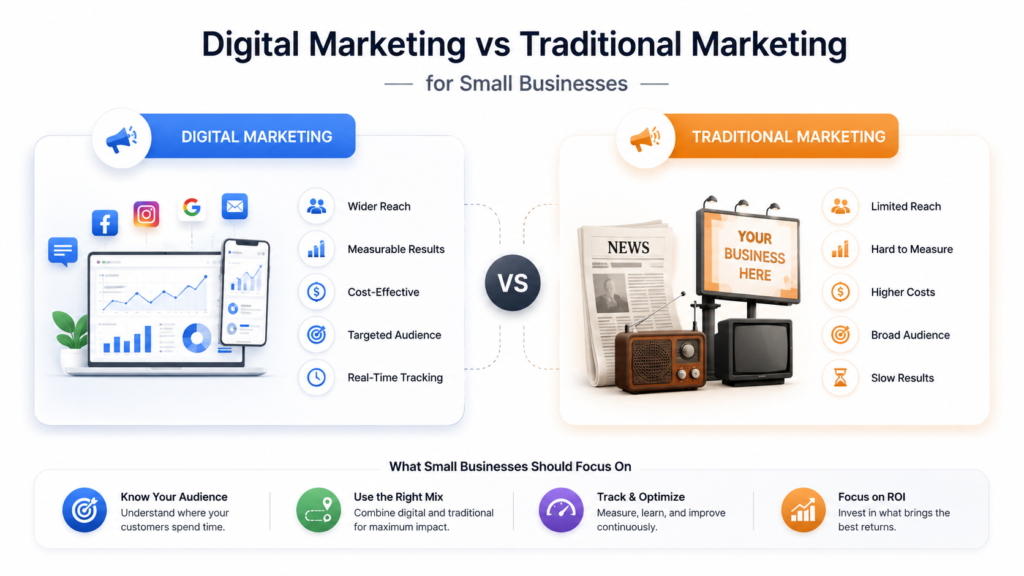
Digital marketing vs traditional marketing is one of the biggest decisions small businesses face when choosing how to promote their products or services. Traditional marketing uses offline channels like newspaper ads, radio spots, flyers, billboards, and direct mail. Digital marketing includes everything that happens online, such as SEO, Google Business Profile, social media, email marketing, and paid ads.
The biggest difference in digital marketing vs traditional marketing isn’t just whether it’s online or offline—it’s the ability to measure results. With traditional marketing, it’s difficult to know which efforts are generating customers. Digital marketing lets you track exactly which channel brought in a lead or sale, adjust your strategy quickly, and stop spending on campaigns that aren’t delivering results.
This ability to measure, optimise, and improve performance is why, in the digital marketing vs traditional marketing debate, I recommend digital marketing for most small business clients.
A Real Client Example: From Guesswork to 35–40% More Inquiries
A year ago, I worked with a local small business that wanted more customers without spending a lot of money on newspaper ads. Instead of choosing traditional advertising, we took a digital marketing vs traditional marketing approach and focused on digital channels.
- We improved their website so it would rank higher in search results.
- We optimized their Google Business Profile so local customers could find accurate business information.
- We created a consistent social media posting schedule to keep the business visible every week.
After about three months, we started seeing measurable results. The website was attracting more visitors through search engines, the business appeared more often in local Google searches, and customer calls and email enquiries increased by 35–40%.
The biggest lesson from this project wasn’t just the increase in website traffic—it was seeing the real advantage of digital marketing vs traditional marketing. Digital marketing allowed us to track exactly which channels were generating leads, identify what wasn’t working, and adjust our strategy quickly. That’s something that’s extremely difficult with newspaper ads or flyers. The ability to measure performance, optimize campaigns, and improve ROI over time is why I recommend digital marketing for most small businesses.
The Biggest Mistake Small Business Owners Make
I’ve seen companies spend a lot of money on traditional advertising even though their ideal customers were already searching for their products or services online. That’s one of the biggest lessons in the digital marketing vs traditional marketing discussion. The outcome is often the same—poor return on investment, missed opportunities, and marketing budgets that aren’t delivering real results.
Before choosing between digital marketing vs traditional marketing, ask yourself:
- Where do my customers go when they need what I offer?
- Are they searching on Google, browsing social media, or reading a local newspaper?
- Can I track and measure how well this marketing channel is performing?
If you can’t confidently answer these questions, that’s the first problem to solve—not how much money you spend on advertising.
Digital Marketing vs Traditional Marketing: A Side-by-Side Comparison
| Factor | Digital Marketing | Traditional Marketing |
| Cost | Generally lower entry cost | Often higher upfront cost |
| Measurability | Highly trackable (clicks, calls, conversions) | Difficult to measure precisely |
| Targeting | Precise audience targeting | Broad, less targeted reach |
| Speed of adjustment | Can change strategy within days | Slow to adjust once printed/aired |
| Best for | Audiences actively searching online | Local communities, older audiences |
| Longevity | Content can keep working (SEO) | One-time exposure per ad run |
When Traditional Marketing Still Makes Sense
Although digital marketing vs traditional marketing is a common discussion, digital marketing is not always the best option for every business. If most of your customers come from your local area or belong to an older demographic, traditional marketing can still deliver strong results. Flyers, newspaper ads, local radio, and community event sponsorships can all be effective when used in the right situation.
Rather than choosing one and ignoring the other, the best approach is often to combine both. For example, a flyer can direct people to your website or Google Business Profile, while a radio ad can encourage listeners to follow your business on social media. In the digital marketing vs traditional marketing debate, the most successful strategy is the one that matches where your customers are and how they prefer to discover local businesses.
How to Decide Which Approach Fits Your Business
I use a framework when I work with clients before I tell them what to do.
First I want to know what my client’s audience does every day. Do they look for things on the internet, scroll through media or do they read local newspapers and listen to the radio?
Then I help my clients set a goal that we can measure. We want to know if we are getting more people to visit our website or if we are getting phone calls or if more people are coming to our store or if we are getting more messages online.
Next we start with something and see what happens. We try one thing like Google Business Profile or SEO for two or three months before we spend a lot of money on it.
If it makes sense we also do marketing. This helps us reach people in our community, especially older people who may not be online all the time.
After that we look at what’s working and what is not and we make changes. With marketing we can see what is working so we use that information to make our plan better.
This framework does not work the same for every business. The people we are competing with, the kind of business we have and how money we have to spend all make a difference. So it is better to be realistic about what we can achieve, than thinking we will get instant results, with digital marketing and my clients’ audience.
Frequently Asked Questions
1. Is digital marketing cheaper than marketing for small businesses?
Digital marketing is usually cheaper for businesses. This is because digital channels like search engine optimization and social media do not cost a lot to get started with. You can also spend less money on these channels depending on how well they are working for your small business.
2. Should a small business use both digital and traditional marketing?
A lot of the time the answer is yes. Using both digital and traditional marketing methods can be an idea, especially for small businesses that have customers in their local area or customers who are older. This is because older customers might not be searching for things
3. How long does it take to see results from marketing?
For one of our clients we started to see results from marketing in about three months. However the amount of time it takes to see results can be different depending on the type of business you have, how many other businesses are doing the thing and how consistently you are working on your digital marketing.
4. Is marketing dead for small businesses?
No, traditional marketing is not dead for businesses. It is still a way to reach some types of customers like people who live in your local area or people who are older.. It works even better if you also have a presence online.ults, with digital marketing and my clients audience.
Final Takeaways
When it comes to digital marketing vs traditional marketing for small businesses, you shouldn’t simply follow what’s popular. Instead, understand who your customers are, set measurable goals, and be willing to adjust your strategy based on real data and results.
If your customers search online for products or services like yours, start with SEO and a well-optimized Google Business Profile. If your audience is mostly local or older, consider adding traditional tactics such as flyers, radio advertisements, or sponsoring local events. The key in the digital marketing vs traditional marketing decision is to track which channels actually bring customers to your business.
The most successful businesses don’t rely only on digital marketing or only on traditional marketing. Instead, they combine both where it makes sense. Ultimately, digital marketing vs traditional marketing isn’t about choosing one over the other—it’s about investing your marketing budget in the channels your customers actually use.